Why 70% of Fashion Shoppers Abandon Their Carts—And How Virtual Try-On Solves It
FADI
Fadi Yousef
Author
December 22, 2025
12 min read
503 views
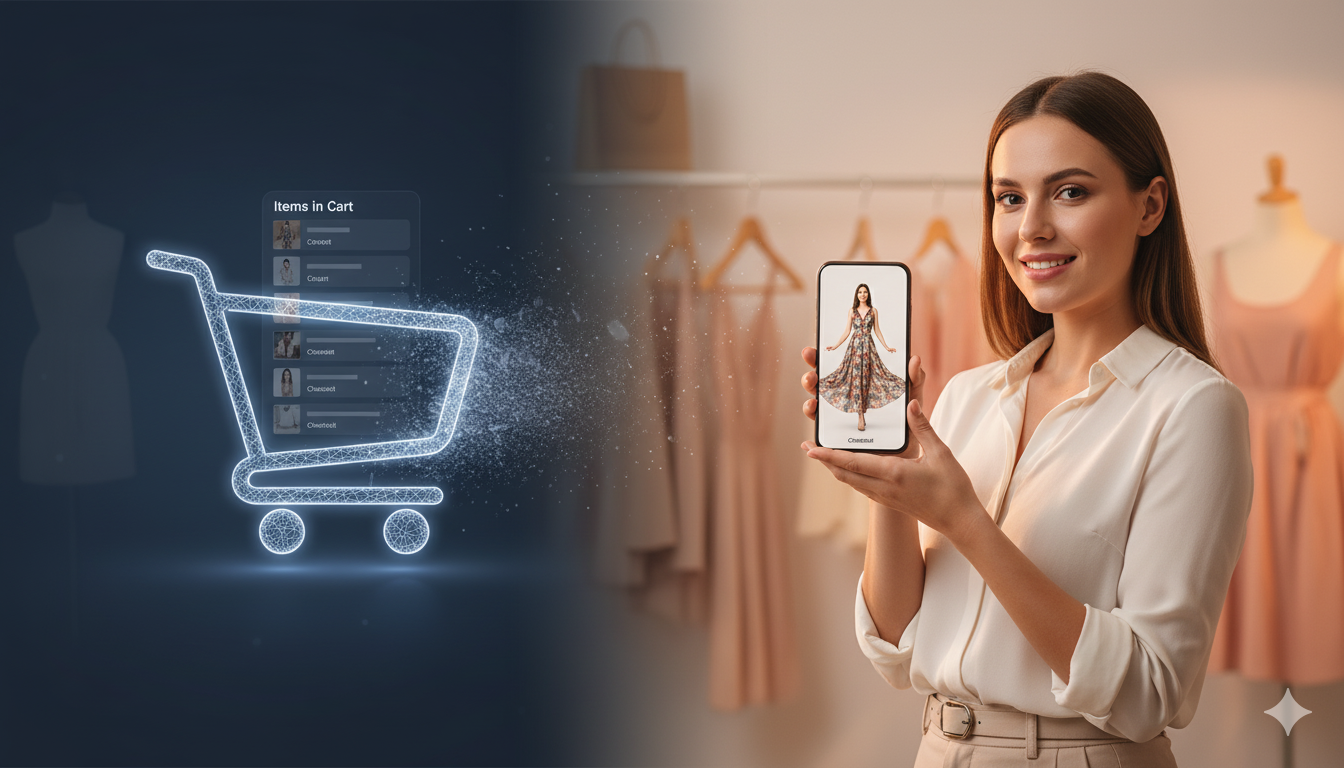
Picture this: A customer spends 20 minutes browsing your online clothing store. They add a beautiful dress to their cart, hover over the checkout button... and then close the tab. Sound familiar? You've just witnessed one of e-commerce's most expensive problems—cart abandonment.
The fashion industry faces a particularly brutal version of this challenge. While the average e-commerce cart abandonment rate hovers around 70%, fashion retailers often see rates exceeding 80%. The primary culprit? Uncertainty. Customers simply can't tell if that gorgeous sweater will actually look good on them.
But here's what's exciting: stores implementing virtual try-on technology are reporting cart abandonment reductions of 25-40%. This isn't just a fancy feature—it's becoming a fundamental shift in how successful fashion e-commerce operates.
In this deep-dive guide, we'll explore the psychology behind cart abandonment, break down exactly how virtual try-on addresses each concern, and give you a practical framework for measuring ROI. Whether you're running a boutique or managing a large fashion catalog, you'll walk away with actionable insights you can implement immediately.
The Anatomy of Fashion Cart Abandonment
Before we can solve the problem, we need to understand it deeply. Cart abandonment in fashion isn't random—it follows predictable patterns rooted in buyer psychology.
The Top 7 Reasons Fashion Shoppers Abandon Carts
Research from Baymard Institute and our own analysis of thousands of fashion transactions reveals a clear hierarchy of abandonment triggers:
- "Will this fit me?" (67% of abandonments) — This is the elephant in the room. Unlike electronics or home goods, clothing is deeply personal. A size M from Brand A fits nothing like a size M from Brand B. Customers know this, and the uncertainty creates paralysis.
- "Will this look good on my body type?" (54% of abandonments) — Even when sizing is clear, customers worry about proportions, drape, and how the garment will complement their specific body shape. A professional model's photo doesn't answer this question.
- Unexpected shipping costs (48%) — This is the most-cited reason across all e-commerce, but in fashion, it's amplified by the mental math customers do: "If I have to return this, I'll lose money on shipping twice."
- "What does this actually look like?" (41%) — Product photography, no matter how professional, can only show so much. Customers want to see garments from multiple angles, in motion, and ideally on someone with similar characteristics to themselves.
- Complicated checkout process (27%) — Every additional step is a chance for doubt to creep in.
- Lack of payment options (22%) — Buy-now-pay-later options have become expected in fashion retail.
- Security concerns (18%) — Particularly relevant for smaller boutiques without established brand recognition.
Notice something? The top four reasons—accounting for over 80% of the abandonment decision weight—all relate to visual and fit uncertainty. These are the exact problems virtual try-on technology was designed to solve.
The Hidden Cost of "Comparison Shopping"
Here's a behavior pattern that doesn't show up in standard abandonment metrics: the comparison shopper. These customers add items to carts at multiple stores, planning to compare options later. They're not abandoning due to uncertainty about your products—they're hedging their bets.
Virtual try-on changes this dynamic dramatically. When a customer can actually see themselves wearing your products, the comparison shifts from "which store should I buy from?" to "which of these items looks best on me?" This subtle psychological shift can double or triple your conversion rate from comparison shoppers.
How Virtual Try-On Technology Works: A Technical Overview
Understanding the technology helps you make better implementation decisions and set realistic expectations. Let's break down what happens behind the scenes.
The Three Pillars of Modern Virtual Try-On
Computer Vision and Body Detection: Modern virtual try-on systems use sophisticated AI models to identify key body landmarks—shoulders, waist, hips, and limbs—from a single photograph. These systems can process this information in under a second, creating a detailed body map that serves as the foundation for realistic garment overlay.
Garment Simulation: This is where the magic happens. The system takes your product images and "understands" the garment's properties—its fabric weight, drape characteristics, and how it responds to body contours. Advanced systems like TryMyLook use diffusion-based AI models that can realistically simulate how a cotton t-shirt will hang differently than a silk blouse.
Real-Time Rendering: The final step combines the body map with the garment simulation to create a photorealistic composite image. The best systems match lighting conditions, skin tones, and even account for partially visible body parts to maintain the illusion.
What Makes a Virtual Try-On Solution "Good"?
Not all virtual try-on solutions are created equal. Here are the key quality indicators to evaluate:
- Realism: Does the final image look like a photograph or a crude overlay? Users are sophisticated—they'll immediately distrust results that look "pasted on."
- Speed: A 30-second processing time might seem acceptable, but in e-commerce terms, it's an eternity. Target under 5 seconds for optimal user experience.
- Consistency: The system should perform equally well across different body types, skin tones, and lighting conditions in user photos.
- Garment Variety: Can it handle sleeveless tops as well as winter coats? Fitted dresses as well as loose blouses?
- Integration Simplicity: A technically superior solution that requires extensive development work may not be practical for most stores.
The Psychology of "Seeing Is Believing"
Let's dive into why virtual try-on works from a behavioral psychology perspective. Understanding these principles will help you implement the technology more effectively and craft better marketing around it.
The Ownership Effect
In psychology, the "endowment effect" describes how people value things more highly once they feel ownership over them. Virtual try-on creates a form of "psychological pre-ownership"—when customers see themselves wearing an item, their brain begins treating it as something they already have.
This is why virtual try-on images should be downloadable and shareable. Every time a customer looks at that image or shares it with friends, the sense of ownership deepens. Some stores report that customers who download their try-on images convert at nearly 3x the rate of those who don't.
Reducing Cognitive Load
Shopping decisions require mental energy. Customers must imagine how products will look, calculate value, assess risk, and predict their future satisfaction. Each of these tasks adds "cognitive load"—mental effort that can lead to decision fatigue and ultimately, abandonment.
Virtual try-on dramatically reduces this load by eliminating the imagination step. Instead of thinking about how something might look, customers can simply see it. This freed-up mental energy can then be directed toward completing the purchase.
Social Proof in a New Form
Traditional social proof comes from reviews, ratings, and user-generated content. Virtual try-on creates a personalized form of social proof—proof to the customer themselves that the item will work for them.
This is particularly powerful for customers who don't identify with the models typically used in fashion photography. When a customer with a different body type than the product model can see the garment on their own figure, it eliminates a significant psychological barrier.
Implementation Strategy: A Step-by-Step Framework
Adding virtual try-on isn't just about installing a plugin—it's about strategically integrating it into your customer journey. Here's a proven framework for maximizing impact.
Phase 1: Strategic Product Selection
Don't enable virtual try-on on your entire catalog at once. Start with products that will benefit most:
- High-margin items where increased conversion directly impacts profitability
- Products with high return rates that could be reduced with better pre-purchase visualization
- Items where fit is critical — blazers, fitted dresses, formal wear
- New arrivals where you want to maximize launch momentum
Phase 2: User Experience Optimization
The placement and presentation of your virtual try-on feature matters enormously:
- Prominent Button Placement: The "Try It On" button should be as visible as the "Add to Cart" button. Don't bury it below the fold or in a secondary tab.
- Mobile-First Design: Over 70% of fashion e-commerce traffic comes from mobile devices. Your virtual try-on experience must be flawless on smartphones.
- Clear Instructions: Not everyone is familiar with virtual try-on technology. Brief, friendly instructions ("Upload a full-body photo to see how this looks on you!") reduce friction.
- Sample Model Option: Some customers aren't comfortable uploading their own photos initially. Providing model options with different body types lets them still experience the feature.
Phase 3: Marketing Integration
Virtual try-on isn't just a product page feature—it's a marketing opportunity:
- Email Campaigns: Abandoned cart emails become dramatically more effective when they include virtual try-on CTAs. "Still thinking about that dress? See how it looks on you →"
- Social Media: Encourage customers to share their virtual try-on images. User-generated content featuring your products is marketing gold.
- Paid Advertising: "See It On You Before You Buy" is a compelling ad message that differentiates you from competitors.
Measuring Success: The Virtual Try-On ROI Framework
Implementation without measurement is just hope. Here's how to quantify the impact of virtual try-on on your business.
Primary Metrics to Track
- Try-On Engagement Rate: What percentage of product page visitors use the virtual try-on feature? Benchmark: 15-30% is good; above 30% is excellent.
- Try-On to Cart Rate: Of users who engage with virtual try-on, what percentage add the item to their cart? Compare this to the overall add-to-cart rate.
- Try-On User Conversion Rate: What's the purchase conversion rate for users who engaged with virtual try-on versus those who didn't?
- Return Rate Comparison: Do orders placed after virtual try-on engagement have lower return rates?
- Average Order Value: Virtual try-on often increases AOV as customers feel more confident adding multiple items.
Calculating True ROI
Here's a simple formula for calculating virtual try-on ROI:
Monthly Benefit = (Additional Conversions × AOV) + (Return Rate Reduction × Average Order) − Processing Costs
Example calculation:
- 1,000 monthly visitors use virtual try-on
- Conversion rate increases from 2% to 3% for these users
- AOV is $75
- Additional conversions = 1,000 × 1% = 10 orders
- Additional revenue = 10 × $75 = $750/month
This doesn't even account for reduced returns, increased repeat purchases from satisfied customers, and the competitive differentiation value.
Common Implementation Mistakes (And How to Avoid Them)
We've seen many stores implement virtual try-on with mixed results. Here are the patterns that separate success from disappointment.
Mistake #1: Treating It as a Gimmick
Some stores implement virtual try-on just to say they have it, placing it in an obscure corner of their site. This approach yields minimal results. Virtual try-on should be a central part of your shopping experience, prominently featured and actively promoted.
Mistake #2: Poor Product Image Quality
Virtual try-on can only be as good as the source images you provide. Grainy, poorly-lit, or inconsistently-shot product photos will produce disappointing virtual try-on results. Invest in high-quality product photography—it improves both traditional browsing and virtual try-on quality.
Mistake #3: Ignoring Mobile Users
If your virtual try-on is clunky or slow on mobile devices, you're missing the majority of your potential users. Test extensively on various devices and connection speeds.
Mistake #4: No Follow-Through
Virtual try-on images should be saved to the customer's account, emailed to them, and available in abandoned cart sequences. Don't let that powerful visualization disappear after the customer leaves the product page.
The Future of Fashion E-commerce
Virtual try-on technology is evolving rapidly. Here's what's on the horizon and why early adopters have an advantage.
Emerging Trends to Watch
- AR Mirror Integration: Technology that projects virtual clothing onto your reflection in real-time, bridging online and offline shopping.
- AI Style Recommendations: Virtual try-on systems that suggest items based on what has looked good on similar body types.
- Size Intelligence: Combined with body scanning, virtual try-on can provide precise size recommendations tailored to each garment's specific fit.
- Social Shopping: Shared virtual try-on experiences where friends can see and comment on each other's potential purchases.
Why Acting Now Matters
Customer expectations are shifting. As more stores adopt virtual try-on, shoppers will begin to expect it as a standard feature. Stores without it will increasingly feel "incomplete" or "risky" compared to competitors offering visualization.
Moreover, early adopters are building valuable datasets—understanding which products benefit most from virtual try-on, how to optimize their photography for best results, and how to integrate the feature into their marketing. These learnings compound over time.
Taking Action: Your Next Steps
Cart abandonment will always be part of e-commerce, but it doesn't have to define your business. Virtual try-on technology represents one of the most effective tools available for addressing the core anxiety that drives fashion shoppers away: uncertainty about how clothing will look on them.
Here's a simple action plan to get started:
- Audit your current abandonment data — identify your highest-risk products and customer segments
- Select a virtual try-on solution that integrates smoothly with your platform
- Start with a focused pilot — 20-50 products that will benefit most
- Establish your measurement framework before launch
- Iterate based on data — expand what works, adjust what doesn't
The stores that thrive in the next era of fashion e-commerce will be those that bridge the gap between online convenience and in-store confidence. Virtual try-on is your bridge.
Ready to reduce your cart abandonment rate? TryMyLook provides AI-powered virtual try-on technology that integrates seamlessly with WordPress and WooCommerce stores. Our solution delivers photorealistic results in under 5 seconds, works across all body types, and requires no technical expertise to implement.